You can ask where the wood came from.
Big Tree’s charcoal is mainly birch, with some willow, made from wood arising through local woodland-management and conservation work around Methven Moss. Andrew prepares the wood, tends the kilns and packs the finished charcoal.
That short connection gives you someone to ask about a batch. “Local” tells you about the source; it is not, on its own, a laboratory measure of heat output or a complete carbon footprint.
Lumpwood keeps the shape of the wood.
Our BBQ charcoal is not pressed into uniform shapes. Pieces vary in size, which is part of working with natural lumpwood. There are no added binders or lighting chemicals in the barbecue range.
When choosing any fuel, read its ingredients and intended use. Briquettes are a different format and their ingredients vary; it would be misleading to say that every briquette is the same, or that every one is unsuitable.
The kiln is part of the story.
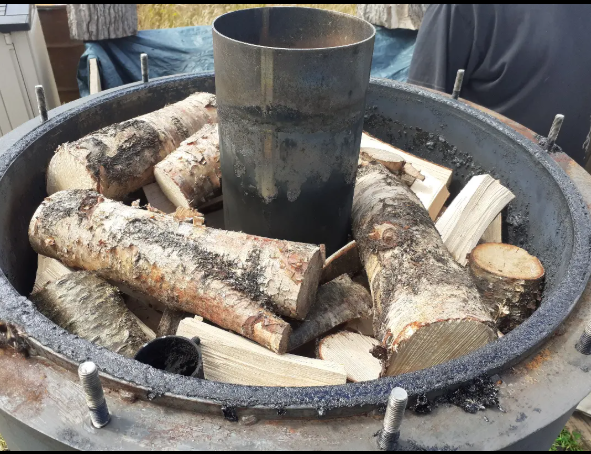
Big Tree uses portable retort kilns built with friends. The wood is heated with a restricted oxygen supply, then the batch is allowed to cool before handling and packing. The process takes attention and time.
We do not give an unsupported “burns twice as long” promise. How a fire behaves also depends on the grill, airflow, fuel load and whether the charcoal has stayed dry.
The small pieces have another route.
Hardwood charcoal fines are an ingredient in our biochar soil improver, blended with aged cattle manure. Our willow artists’ charcoal is a separate product made for drawing. The label tells you which job each product is intended for.
What to ask before you buy
- What wood or other ingredients are in the product?
- Where was it made, and can the supplier explain its source?
- Is the format right for your equipment and cooking?
- Are performance claims supported by tests, or simply marketing?